
The Aravalli range, one of the oldest mountain systems in the world, is not just a geological wonder but a critical ecological shield for North and Northwest India. Stretching across Gujarat, Rajasthan, Haryana, and Delhi, the Aravallis act as a natural barrier against desertification, regulate groundwater recharge, and moderate climate conditions in the National Capital Region (NCR). While environmental degradation of the Aravallis has intensified due to mining, real estate expansion, and deforestation, Section 51A of the Indian Constitution provides a powerful constitutional basis for citizens to step in and protect this fragile ecosystem.
Understanding Section 51A: Fundamental Duties of Citizens
Article 51A was introduced into the Indian Constitution by the 42nd Constitutional Amendment Act, 1976. It lays down the Fundamental Duties of every citizen of India. Unlike Fundamental Rights, these duties are not directly enforceable by courts, but they play a crucial role in shaping laws, public policy, and judicial interpretation.
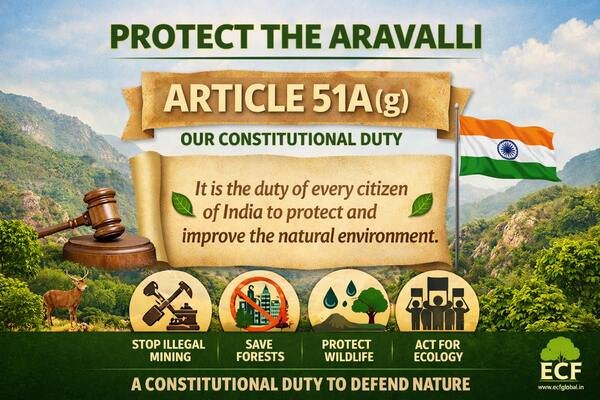
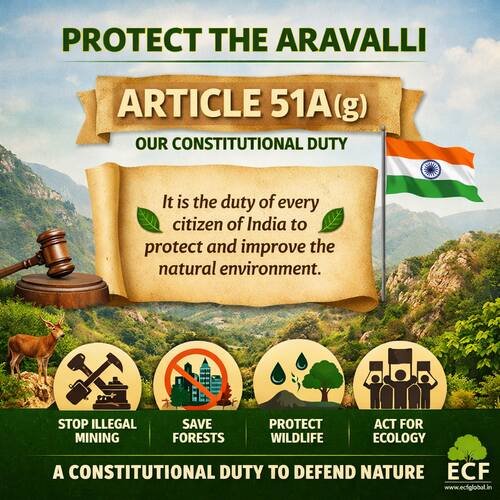
Among the listed duties, Article 51A(g) is particularly significant for environmental protection. It states:
“It shall be the duty of every citizen of India to protect and improve the natural environment including forests, lakes, rivers and wildlife, and to have compassion for living creatures.”
This clause constitutionally mandates citizens to act as environmental custodians, making environmental protection not merely a moral obligation but a constitutional duty.
From Duty to Empowerment: How Section 51A Supports Environmental Action
Although Section 51A does not grant an explicit “right,” Indian courts have consistently interpreted Fundamental Duties as complementary to Fundamental Rights, especially Article 21 (Right to Life), which includes the right to a clean and healthy environment.
In several landmark judgments, the Supreme Court and High Courts have relied on Article 51A(g) to:
- Justify environmental regulations
- Support public interest litigations (PILs)
- Hold governments and private entities accountable
This judicial approach effectively empowers citizens to act in defense of natural resources like the Aravalli hills.
Section 51A and the Protection of the Aravalli Range
The Aravallis have been under relentless pressure from:
- Illegal and excessive mining
- Real estate development in eco-sensitive zones
- Forest land diversion
- Weak enforcement of environmental laws
Citizens, environmental groups, and civil society organizations have repeatedly approached courts to halt ecological damage in the Aravallis. In many such cases, courts have invoked Article 51A(g) to emphasize that environmental protection is a shared responsibility of the State and citizens.
Judicial Recognition
Courts have acknowledged that:
- Citizens have locus standi to file PILs for environmental protection
- Environmental harm violates the spirit of Article 51A
- Government inaction in protecting ecologically sensitive areas contradicts constitutional values
This means that Indians are constitutionally justified in opposing activities that harm the Aravallis, whether through litigation, advocacy, or community action.
Linking Section 51A with Sustainable Development
Protection of the Aravalli range is not anti-development. Courts have repeatedly stressed the doctrine of sustainable development, which balances economic growth with environmental preservation. Section 51A(g) strengthens this balance by reminding citizens and authorities that development cannot come at the cost of ecological collapse.
The degradation of the Aravallis directly affects:
- Air quality in Delhi-NCR
- Groundwater depletion
- Rising temperatures and heatwaves
- Increased desertification
Thus, protecting the Aravallis aligns with the constitutional vision of intergenerational equity, ensuring that future generations inherit a livable environment.
Citizen Action Backed by the Constitution
Section 51A empowers citizens in practical ways:
- Filing PILs against illegal mining or construction
- Participating in environmental impact assessment hearings
- Holding local authorities accountable for environmental violations
- Promoting conservation awareness at the community level
Environmental activism in India is strongest when rooted in constitutional values, and Article 51A(g) provides that foundation.
Conclusion: A Constitutional Call to Protect the Aravallis
The protection of the Aravalli range is not just an environmental necessity—it is a constitutional responsibility. While Section 51A does not grant a standalone legal right, it creates a powerful moral and legal framework that enables citizens to act, speak, and seek judicial intervention to protect nature.
In a time when climate change, air pollution, and water scarcity threaten India’s future, Article 51A(g) transforms every Indian into a stakeholder in environmental preservation. Safeguarding the Aravallis, therefore, is not activism alone—it is the fulfillment of a constitutional duty that strengthens India’s democratic and ecological foundations.
For More, follow us on Instagram – ECF Global or Become a Green Ambassador – Hit the Contact Us Page or email us at info@ecfglobal.in